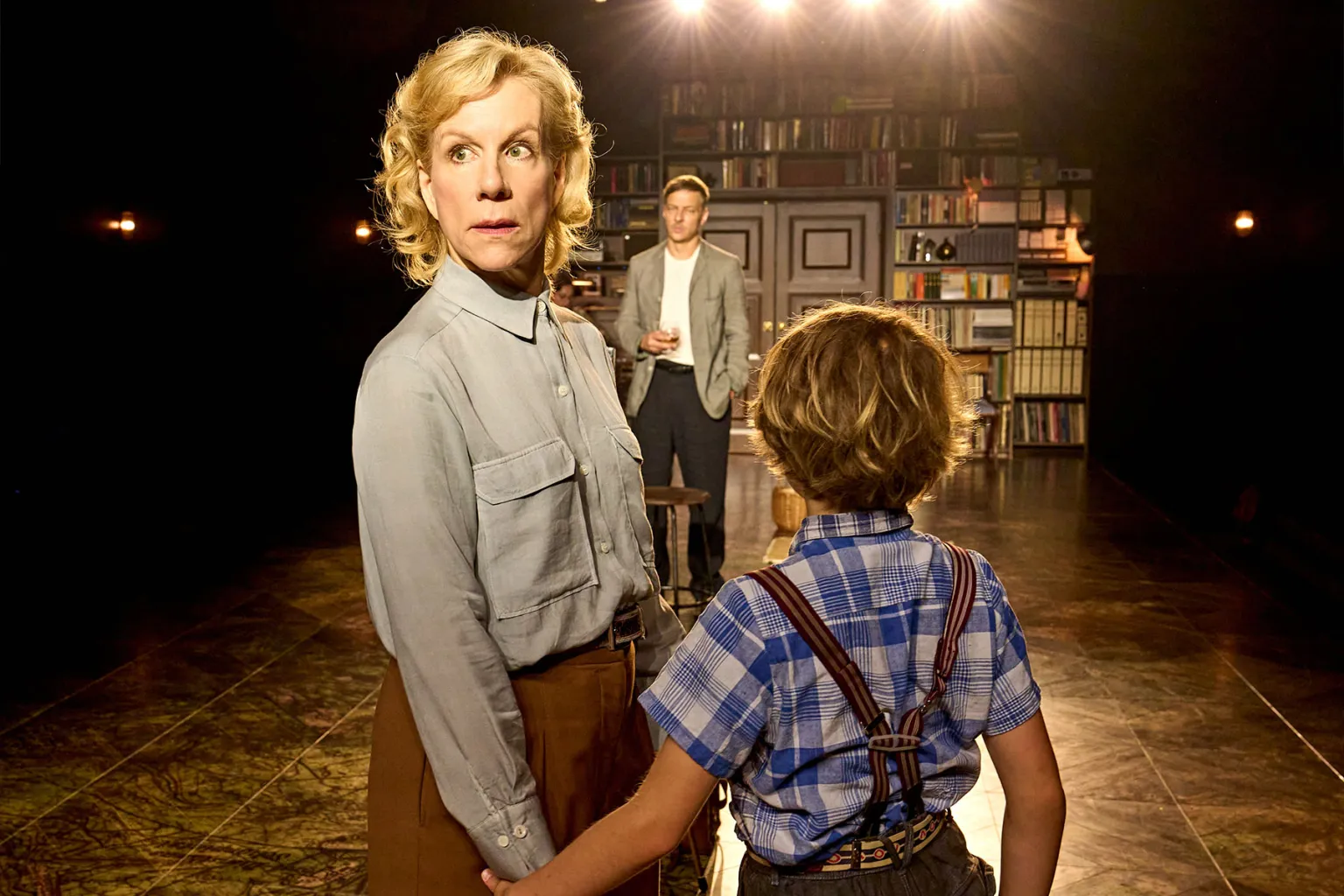
We round up the reviews for David Lan’s new play, running at the theatre’s Dorfman space until the 1st November.

WhatsOnStage: *** “Under Daldry’s careful hand, the action is always moving on. But the direction cannot disguise the fact that the play is too long, circling back on its arguments, and becoming over-extended and flat in the process. Yet it never loses its relevance. The children – apart from Thomas – are never seen, but we hear their voices in Gareth Fry’s superb sound score. The echoes ring down the years to the voices of children in Ukraine and Gaza today. It’s a sound worth remembering.”
Time Out: *** “What Lan puzzles out so carefully is the human need to do any tiny thing you can in the face of awfulness – like taking in a child – and the reverberating consequences those actions can have. Although a deeply human play, and one so carefully written, with an occasional poeticism that lifts this away from simply being Hollywood fodder (though this would definitely make a great film), there is also a stiffness that stifles the emotion. It’s a blast of theatricality and a triumph of intellect which has obvious lessons for our times, even if they sometimes drown out the heart.”
The Guardian: *** “Stevenson gives a typically muscular performance, but it is Artie Wilkinson-Hunt, playing the young Thomas on press night, who well and truly steals the show. Under the direction of Stephen Daldry (who famously elicited a superb performance from Jamie Bell in Billy Elliot), he is an initially angry, mercurial and fearless force in the lives of Ruth and the GIs. Wilkinson-Hunt is an absolute whirlwind, baleful, melancholy and tender by turns. A star in the making, without a doubt.”
The Reviews Hub: **** “Daldry’s staging is, at many times, thrilling. The chaos of post-war Germany and the race across a hostile continent are realised vividly and imaginatively with a company of 15 adults and children. However, there are moments when it feels as if the production is at odds with the play, overwhelming it. Lan has realised that events of such magnitude can only be dramatised by condensing them into the lives of individuals, but Daldry chooses to paint the bigger picture. It is significant that the play’s most moving and memorable scenes come when fewer numbers occupy the stage. Specially, Stevenson and Wlaschiha give astonishingly powerful performances that shine through all the spectacle that surrounds them.”
London Theatre.co.uk: *** “It’s a real treat to see Stevenson in such an epic central role – she’s on stage for nearly the duration – and she effortlessly holds the focus. Her scenes with Wilkinson-Hunt are especially moving as she shows him both maternal protection but also the respect these children were denied during the war (against the mores of the time she allows his frequent violent rages to play out, and even joins in with them at one point). As is often the case in such dramas, focussing in on one child’s story serves to highlight the horror that so many were involved.”
All That Dazzles: **** ” There are several factors to be wowed by in this play – one of which is Stephen Daldry’s remarkable direction. No stranger (pun intended) to bold and inventive staging, he has done it again with The Land Of The Living, with every choice stunning to witness. From the placement of characters and their use of space around the theatre to how best they manage to convey the story for all of its emotion, Daldry delivers a near-faultless production that speaks to the urgency of Lan’s story – unflinching and uncompromising, it is quite distinct in its style, but that makes it all the more memorable.”
The Stage: *** “David Lan’s new play is a powerful, if overlong, look at identity and belonging amid the rippling tragedy of children displaced during conflict.”
London Unattached: *** “The Land of the Living is certainly prescient, not only because of how it relates to the multiple devastating conflicts occurring around the world at the moment, but also because it explores belonging and what it means to be displaced. Can an absent sense of belonging be re-established? While the play is decidedly not the most interesting work done on this subject, it acts as an important reminder to stand with people who cannot return home.”
West End Best Friend: **** “The National Theatre has delivered a production both historical and powerful, it reminds us of the lasting scars of conflict, carried most clearly in the voices of the young which can be a lesson for all.”
West End Wilma: ***** “The Land Of The Living is an uncomfortable reminder that the world today is sadly not much different to how it was seventy-five years ago. People, from all over the world, through no fault of their own, are crying out for help from those more fortunate than others. Does humanity care more, or less, about these people now than they did then? Sadly, I think things could be getting worse.”
London Theatre 1: *** “The traverse staging felt like watching a tennis match at the Wimbledon Championships, with some audience patrons craning their necks back and forth to look at whoever was speaking. True, nobody forced them to do that, but the alternative would have been to treat the show like a radio play, and there wasn’t a sufficient level of description to have made that feasible.”
Broadway World: **** “On the whole, this timely production reminds us of the human side of war, and highlights the subjectivity of morality in highly pressurised situations. Gripping, poignant and, at times, chilling – put it on your ‘must watch’ list.”
The Telegraph: **** “The Land of the Living’s superbly crafted production plunges us into a world of horror and confusion.”
The Standard: *** “There are some knockout performances. Kate Duchene plays the flustered aid worker Dora with deeply ingrained humanity, while Wilkinson-Hunt is a diamond in the rough. Switching languages without missing a beat and hurling plates in rage across the theatre, his presence is electrifying. In a production that sometimes feels hollow, he remains its beating heart.”
The Upcoming: **** “The Land of the Living is powerful and important, especially for audiences unfamiliar with the Lebensborn programme. At two hours and 45 minutes (including interval), it can feel lengthy at times, yet you’re compelled to see what unfolds next. Its relevance is undeniable: the daily images we witness – children uprooted by conflict, robbed of home and future – echo profoundly throughout the performance. Children remain, as always, the most haunting symbols of injustice.”
To book tickets visit: https://www.nationaltheatre.org.uk/productions/the-land-of-the-living/