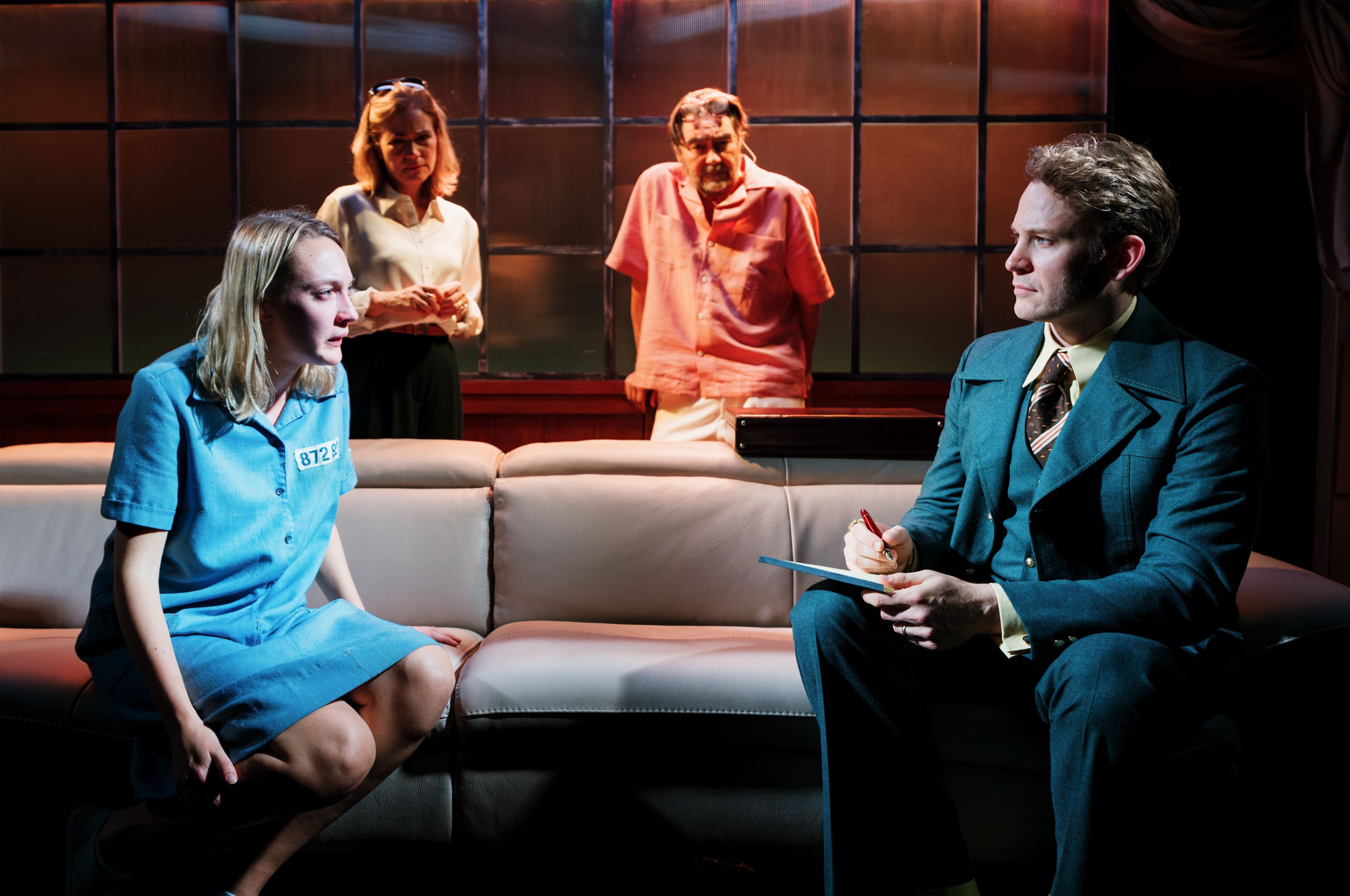
We chatted to Katie about starring in Ragdoll at the King’s Head Theatre.

Hi Katie, what can we expect from ‘Ragdoll’? Hi! Ragdoll is a sharp, funny whirlwind of a play based on one of the most fascinating events in modern American history. At its heart, it’s about the relationship between Holly, a traumatised heiress at the centre of a scandal, and her brilliant, success-obsessed attorney, Robert. The play zips back and forth between the turbulent trial of the 1970s and the MeToo movement of 2017. Audiences can expect nuanced characters, snappy dialogue, and a richly immersive world.
What were your first impressions of Katherine Moar’s play when you read it initially? I fell in love with Katherine’s writing style instantly. The play has an excellent flow and rhythm, and the characters are razor-sharp and quick-witted. The exchanges feel like a tennis match between the characters, even the quieter moments are charged and full of depth. I was especially struck by how well drawn the relationships are, the specificity of where the characters find themselves in relation to one another across many years.
How has it been working on the show so far? I’m having such a great time working with this brilliant team on the show, getting to bounce off of Ben, Abi and Nat is such a treat, I’m learning so much from them all the time. Working with Josh is always a dream. I can always trust I’m in safe hands with him which allows for a playful and curious working environment. And having Katherine in the room with us is invaluable. She’s so open and receptive. The whole process has felt fresh and collaborative.
This is a play that seems to examine our fascination with fame and scandal – why do
you think as a society we are so fixated on these? I think as a society we have always loved stories and mythologising. We project our own wishes and desires on to “celebrities” as a means of escapism. On some level, we love it when they falter, or fall from grace, because it’s reassuring to find the people we have idolized or put on pedestals also falter. It helps us draw our own lines of morality and decide
what we can or cannot accept. The media amplifies this as outrage always seems to sell, and then with social media today, the boundaries between us and them are blurred, creating the illusion of intimacy despite having no real relationship with them. I think the play does a brilliant job of exploring this, it asks us questions on how we respond when a very public person who has been victimised does not behave in the way we expect them to.
How do you see your character? The Heiress was born into immense privilege and wealth and this can make her naïve. She has been through an incredibly traumatic experience and now finds herself on trial for armed bank robbery. She is complex, intelligently observant but also childish at times, funny, quick and self-confident yet vulnerable. It’s so much fun to have all these contrasts in a character, and it makes her such an exciting role to get to play.
The story we see unfolding in ‘Ragdoll’ is inspired by the case of Patty Hearst – did
you do your own research into this case to help build up your understanding for your character? There is an overwhelming amount of information out there, and so many people have conflicting opinions on the case. I’d done a lot of reading before we started, but my main resource has been Patty’s memoir, Every Secret Thing. I feel very lucky to have that to read and refer to, it has been enormously helpful in getting inside my character’s head and understanding what she was feeling at the time.
What are you looking forward to about presenting ‘Ragdoll’ for audiences? I’m really excited to see what audiences take from the play. I think it brings up so many
questions around memory and culture and perception and we are really hopeful that the
audience will come away having conversations and questions for each other.
By Emma Clarendon
Ragdoll continues to play at the Jermyn Street Theatre until the 15th November.