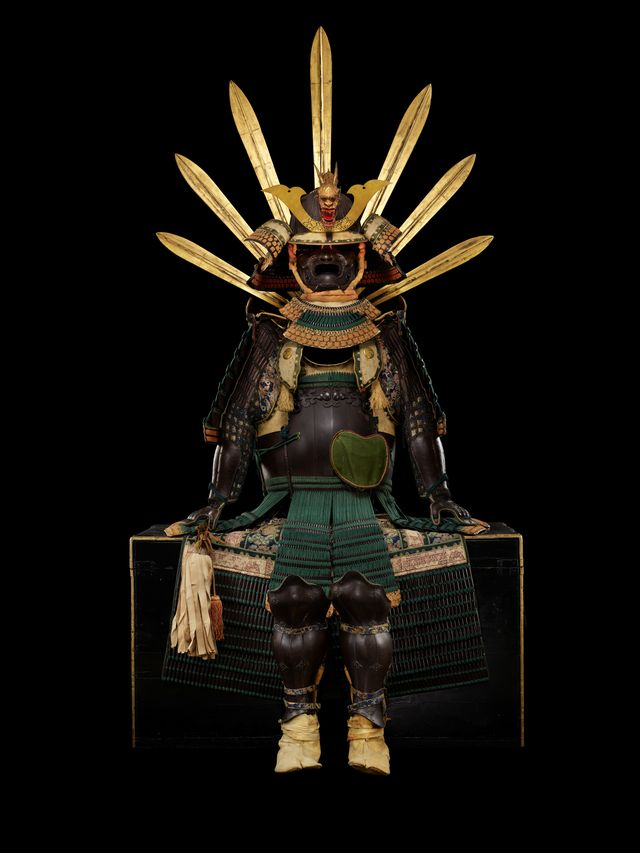
This deeply immersive exhibition offers a really fresh perspective on how there was much more to the Samurai than simply being warriors.

Iron, silk, wool, leather, gold and lacquer, Japan,
1519 (helmet) , 1696 (armour) and 1800s (textiles). Purchase made possible by the JTI Japanese
Acquisition Fund. © The Trustees of the British Museum
It is extremely clear from start to finish of this expansive exhibition that the British Museum have left no stone unturned in terms of exploring the legacy of the samurai and why we continue to be fascinated by them.
Exploring the history of the samurai through its rise and fall, this show highlights the fact there was plenty more to them than simply being warriors ( the display even explains that sometimes a battle wasn’t required and they would have tea to help try and solve disputes) – but also their involvement in the arts and the careers that they found after retirement. But the biggest surprise for me was the fact the samuari also included women.
The legacy of the samurai is effectively explored through a dazzling range of objects such as the armour that they would wear, scrolls that outlined in details some of the most major battles they took part in, partition screens and plenty of wonderfully detailed helmets that all bring this fascinating period of history to life. Every object and aspect of this display captures the many different elements to the samurai way of living and while the early aspect of the exhibition focuses on the warrior aspect, it really begins to flourish as it delves into their lives and way of living away from battles.
Throughout, the display feels wonderfully immersive, bathed in deep coloured lighting with scenery (some of which moves early on) that is wonderfully haunting and makes for a perfect back drop to the objects being displayed. There is a sense of deep drama and respectfulness that draws the visitor in from start to finish.
As well as the objects and history itself, the display also captures how the fascination with the samurai continues to this day and is still reflected in popular culture today through graphic novels, films and television series. It was a bit of a surprise to see a Darth Vader costume on display (I certainly wasn’t expecting to find out that George Lucas was influenced by the Samurai for Star Wars).
The whole exhibition has been elegantly curated and it moves seamlessly from one section to the next. However, given the number of people coming to see the exhibition at one time means that it can be difficult to see absolutely everything, while the end of the display feels a little bit flat in the delivery.
Overall, this exhibition is a wonderful insight into the world of the samurai that is really worth more than one visit. Brilliantly curated with a delightful range of objects on display, it is a very rich and in the right way educational experience.
By Emma Clarendon
Rating: ❤️❤️❤️❤️❤️
Samurai continues to be on display at the British Museum until the 4th May.