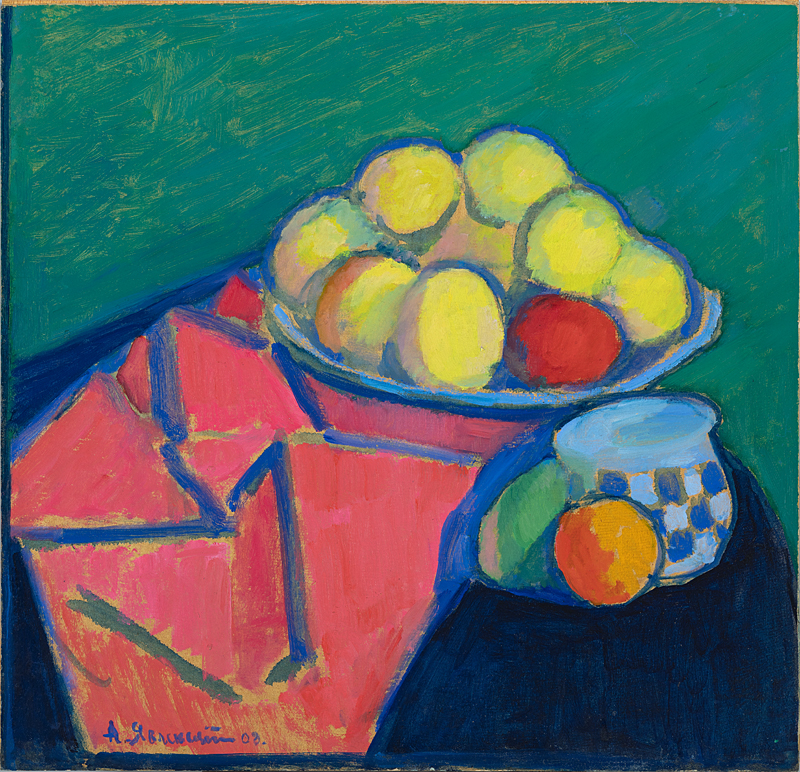
The exhibition highlights the gallery’s move into the 20th century and beyond with its collection.

Alexej von Jawlensky 1864 – 1941 Still life with apples, 1908
Museum Wiesbaden
photo © Museum Wiesbaden
The National Gallery has announced that it will present its first exhibition of modern paintings from Germany – and its first devoted to an artistic movement after 1900 next spring.
On display from the 20th March until the 1st August 2027, German Expression: Modern Painting 1900-1918 will be the first show to o chart the work of both of the movement’s pivotal groups Die Brücke (The Bridge) and Der Blaue Reiter (The Blue Rider) – who were active from 1900 until the end of the First World War.
It will feature a number of loans from Germany’s most prestigious modern art collections, such as Berlin’s Neue Nationalgalerie and Brücke Museum and the Museum für Kunst und Gewerbe, Hamburg. The aim of the show is to present a alternate history of Modernism, to the predominantly French focus of the National Gallery’s current post-1800 collection.
While the featured artists Wassily Kandinsky (1866-1944), Gabriele Münter (1877-1962), Franz Marc (1880-1916) and Ernst Ludwig Kirchner (1880-1938), worked across many media, the exhibition celebrates the remarkable achievements of these artists in painting – the electrifying colours, energetic brushstrokes, and formal fragmentation that opened the doors to Abstraction.
Talking about the news, Sean Rainbird, co-curator, says: ‘A critic first used the term ‘Expressionism’ before the First World War to describe modern painting from France and Germany. He also predicted the term would, in the future, be most closely associated with art from Germany. There were several pre-eminent individual Expressionist artists from Germany and Austria, but some of the best known belonged to two now-famous groups. This exhibition is the first time for many decades that both – called the Brücke and Blue Rider – have been combined for an exhibition in Britain and Ireland. It offers a unique opportunity for visitors to experience the artists’ bold colours, formal innovations, spiritual aspirations and strength of individual expression, boldly extending the current parameters of the National Gallery’s displays into the early 20th century.’
To find out more visit: https://www.nationalgallery.org.uk/exhibitions/german-expressionism-modern-painting-1900-1918