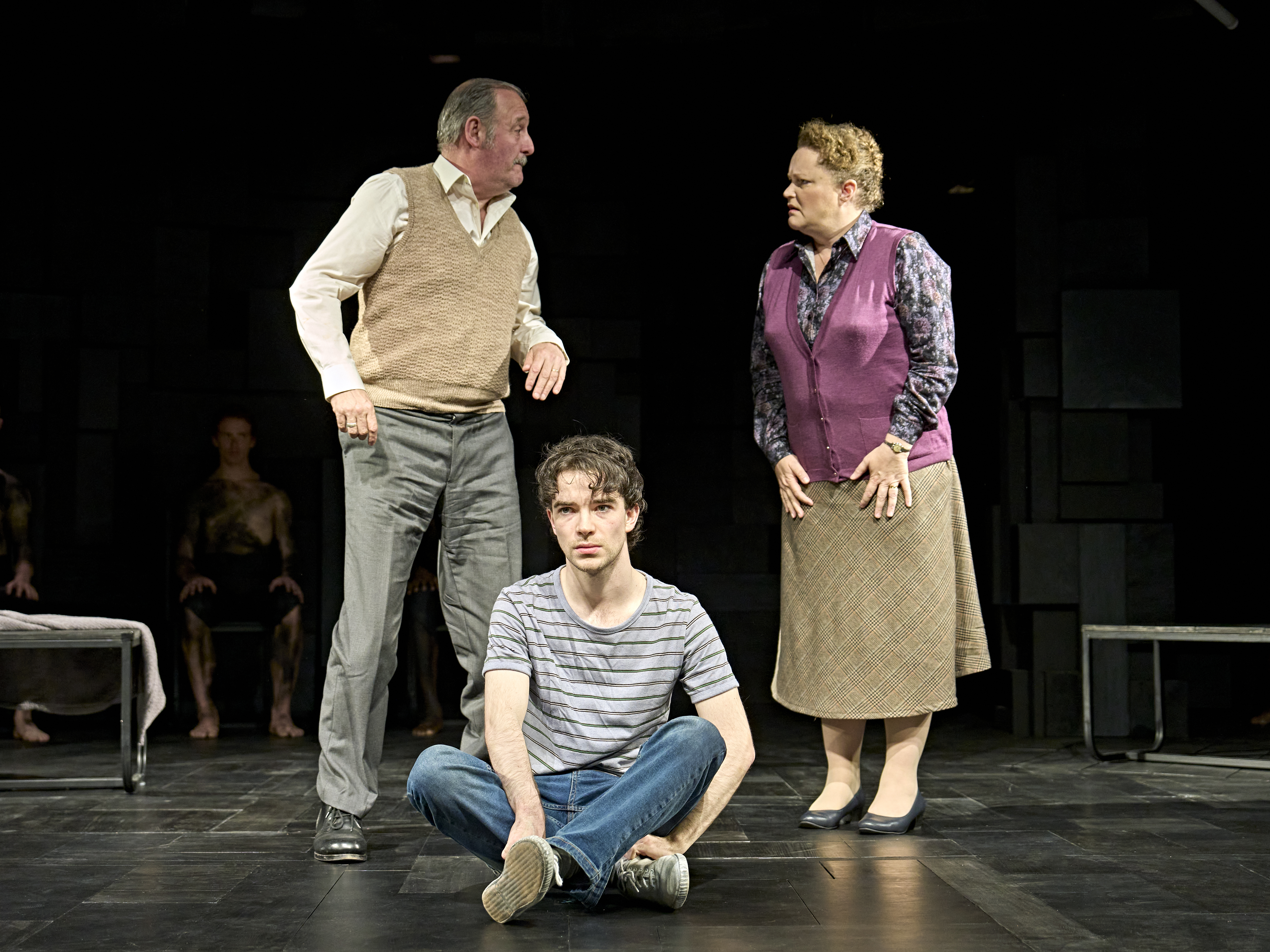
Find out how critics have been reacting to Lindsay Posner’s revival of Peter Shaffer’s play.

Broadway World: ***** “The Menier is a brilliant venue for the production, small enough to convey the intense claustophobia in the play, but also to appreciate the strength of the actors at such intimate quarters. It feels almost voyeuristic, peering into the darkness of Paul Farnsworth’s stark set. Posner approaches the famous nude scenes with delicacy and thoughtful care, but leans into the inherent unease in the play. It is not an easy watch, but a hugely moving and compelling one.”
WhatsOnStage: **** “Both production and performances give this acknowledgement full scope. Stephens, almost unrecognisable behind thick-framed glasses and bushy beard, makes Dysart’s doubt a force for empathy rather than self-pity; he is fascinated by his patient for his own reasons, but he also desperately wants to reconcile the forces that are tearing both Alan and him apart. His great stillness, his emotional listening, contrasts with Valentine’s jumpiness as Alan, his constant twitching of loosely clenched fists.”
London Theatre.co.uk: **** “The second act finds Stephens building to an admirable fury of his own as he further questions whether his patients might not in fact be “victims”, however fully he is committed to toppling Alan from his psychotic perch. There’s a neat synergy in finding this role in the capable hands of the son of the actress, Dame Maggie Smith, for whom Shaffer wrote his much-loved play Lettice and Lovage, which is a comic variant in the study in contrasts on view here. What matters in Equus is the fearless study in extremities that Dysart tells us early on “is the point”: this production, as it must be, is a wild ride.”
The Guardian: **** “Posner’s production leans into the question of where we place blame, with Colin Mace’s stoic father lumping it into the lap of Alan’s mother, a downtrodden Emma Cunniffe. But in Stephens’ shrink we see something deeper and more destructive as he worries about ridding Alan of his demons: a question of what a life is worth if it is lived without a world-burning devotion.”

All That Dazzles: ***** “With inspired direction and design, this is a dark and brooding Equus that doesn’t so much gallop to the finish line, but instead opts for a slow trot, proving that in situations like this, slow and steady really can win the race. Though there is much to celebrate about this Equus, it is Noah Valentine’s performance that proves to be the top selling point – still a relatively new, young actor – this phenomenal feat suggests we will be seeing a lot more of Valentine on stage in the years to come – it feels fitting to say a star is born when it comes to him, but it is the truth.”
Time Out: **** “Toby Stephens is superb in this powerfully intimate revival of Peter Shaffer’s unsettling masterpiece.”
The Standard: **** “Posner’s production does the same and embraces the play as a period piece, including its ridiculous moments (Alan’s invented equine scripture involves horses called Spunkus and Spankus, for example). It’s staged on a circle within a square, the six silently-seated horse-men surrounded by Gormley-esque cuboid walls pierced with rods. A fine revival of a deeply odd but significant play. The neighs still have it, it seems.”
The Reviews Hub: ***** “50 years after it was first staged, this production feels fresh and relevant in a world where mental health is on everyone’s mind. There may be dated references to the TV ads of the Seventies that Strang initially uses to deflect Dysart’s questions, but the sheer quality of the writing, the performances and the lighting create a totally absorbing tour de force performance that deserves to be seen by a wider audience in the West End and beyond.”

The Telegraph: **** “This raw, stripped-back revival of Equus at the Menier Chocolate Factory is driven by a fierce, breakout turn from Noah Valentine.”
The Stage: **** “Powerful and precise revival of Peter Shaffer’s equine psychodrama.”
Theatre Weekly: ***** “What emerges is a production that preserves the play’s essential ambiguity. It refuses to side with rationalism over obsession, or civilisation over instinct, instead leaving us suspended between them, questioning whether the cost of “normality” might be too high. This Equus feels acutely contemporary in its exploration of masculinity, repression and the search for meaning. It is, ultimately, a superb revival, unflinching in its gaze, precise in its execution and deeply affecting in its impact.”
To book tickets for the London run visit: https://www.menierchocolatefactory.com/tickets/equus/