The exhibition will go on display from the 7th October until the 14th February 2027.

It has been announced that the Whitechapel Gallery will present a major exhibition celebrating the work of Cecilia Vicuña, one of Latin America’s most internationally renowned artists, poets, and feminist activists.
Spanning across six decades, this show will provide a unique opportunity to explore Vicuña’s interdisciplinary practice, which intentionally dissolves the boundaries between visual art, poetry, performance, ritual and activism, and encompasses painting, textile, photography, installation and film.
A key part of Vicuña’s work is her commitment to honouring and preserving ecosystems and indigenous systems of knowledge. She regards the destruction of the natural world and erasure of indigenous communities as interconnected forms of violence and sees their recovery and preservation as the only way to imagine and create alternative futures. Many of her installations function as acts of remembrance for cultures, languages and ways of being that have been suppressed by dominant Western models and colonial systems.
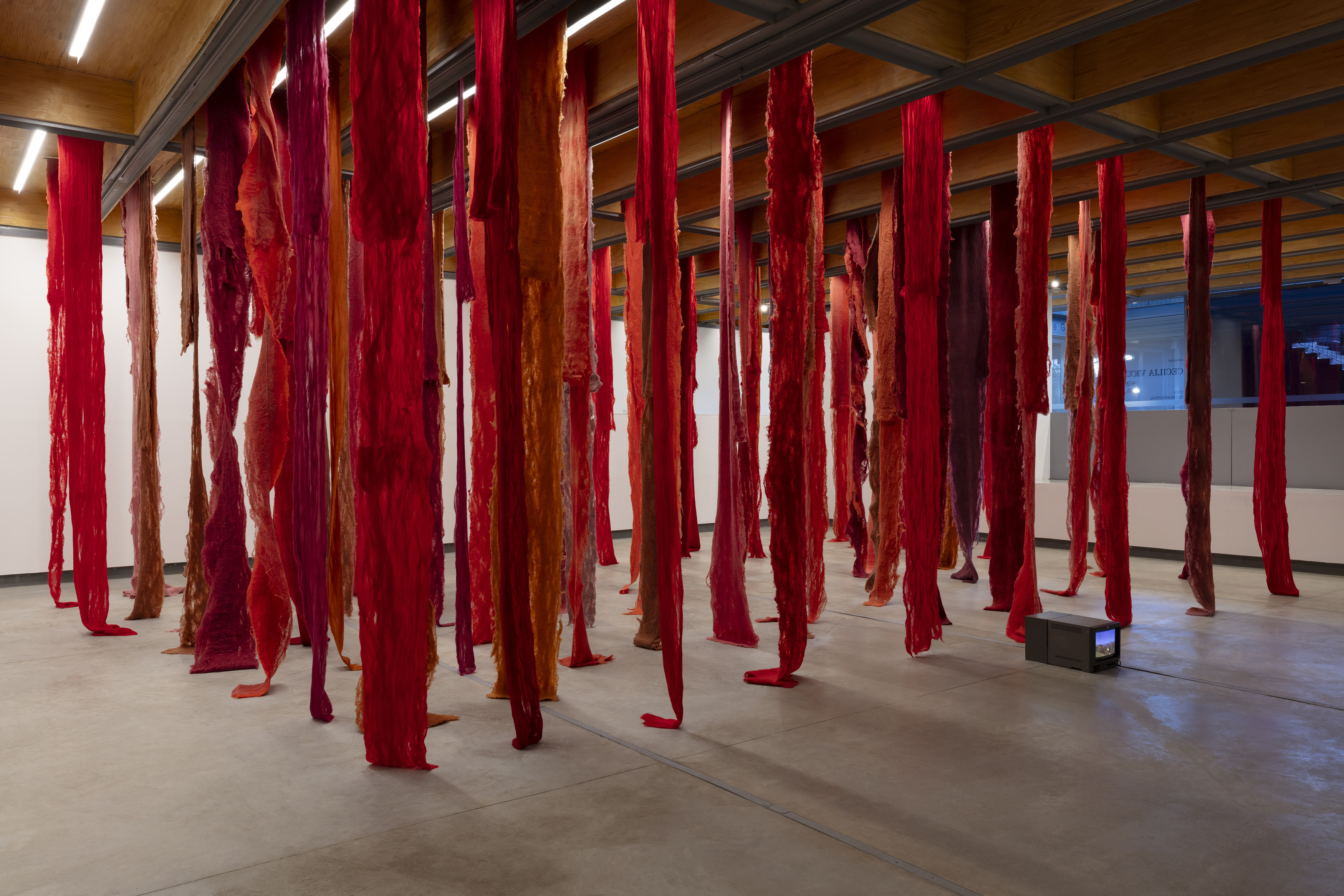
The exhibition will begin with Quipu Menstrual (2006–2024), a dense sculptural installation of unspun wool in vivid shades of red and brown suspended from the ceiling. Vicuña has been creating ‘quipus’ (knots) for over 50 years as striking embodiments of an ancestral, non-alphabetic communication system rooted in Andean culture.
Another key aspect of Vicuña’s artistic language are the series of works titled precarios. She began making these small sculptures in the mid-1960s, crafted from hand-bound booklets, newspaper cuttings, papers, prints, fabric, feathers and other found materials. Originally laid out on the beach for the high tide to erase, these fragile ‘spatial poems’ are defined by their ephemerality and challenge conventional understandings of sculpture as fixed or permanent, offering instead a poetic counterpoint to the extractive logics of colonisation and capitalism. Vicuña’s only surviving precarios from her time in London, Precarios: A Journal of Objects for the Chilean Resistance (1973–74), will be shown alongside archival documentation of the 400 lost works from the same collection.
Also on display are a series of works dedicated to Vicuña’s performances and interventions in public spaces which she has been developing from the 1960s to the present day. These include the short film What is Poetry to You? (1980). Filmed in the vibrant streets of Bogotá, where she was based from 1975 to 1980, the work presents a series of intimate encounters where Vicuña asks various individuals, from children and street performers to scientists, artists, and sex workers, the same question: ‘What is poetry to you?’.
The exhibition will then continue with a dedicated display on Artists for Democracy (AFD), the organisation Vicuña co-founded in London in 1974 with David Medalla, John Dugger and Guy Brett in solidarity with Chile and other liberation struggles worldwide. This section brings together never-before-seen documents, photographs and printed materials, offering insight into both the collective’s activities and Vicuña’s formative time in London.
Concluding the exhibition is Ciudad Geométrica (2025), a new large-scale installation presented in the UK for the first time. Composed of ephemeral materials such as driftwood, feathers, shells and bones, the installation brings together elements collected in Belgium, Chile and New York, forming a minimalist ‘geometric city’. Vicuña originally trained in architecture before turning to art, and these structures echo the sculptural logic of Andean pre-Hispanic architecture as well as offering an alternative form of world-building.
To find out more visit: https://www.whitechapelgallery.org/exhibitions/cecilia-vicuna/