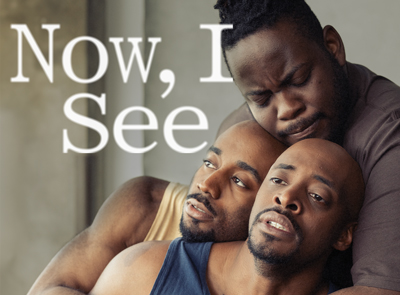
This powerful and moving tale of two brothers learning to reconcile and dealing with unexpressed emotions is compelling to watch from start to finish.

On leaving the Stratford East Theatre on watching Now, I See, there were a group of young black men saying to each other ‘let’s talk about our feelings more’ – proving just how powerful theatre can be in terms of breaking boundaries and helping to bring about change.
Written and directed by Lanre Malaolu, Now, I See is the second of a trilogy of plays exploring what it means to be a Black man living in contemporary Britain. Told through movement, music, monologues and raw emotion it is a story of two brothers attempting to reconnect at the memorial of their third brother.
Adeyeye (the third brother who is still a strong presence on stage thanks to Tendai Humphrey Sitima’s quiet charisma) was the only one out of the siblings to have sickle cell, sadly more commonly found in Black communities and can cause extreme pain and fatigue as well as reducing life expectancy. At his memorial and beautifully using movement and memory, his brothers Kieron and Dayo, attempt to confront their feelings about their brother and how his condition affected them differently in their relationship with him.
Kieron (Oliver Alvin-Wilson) is more restrained emotionally, refusing to look back but as the show goes on his vulnerability and pain exposes more about how he felt he had to be strong, asking serious questions about what it means to be a Black man in the 21st century and not being able to show weakness. In contrast, Dayo is more emotionally open – even going to a therapist, while desperate to reconnect with his brother.
There is a whole bittersweetness feel to the whole production, enhanced by some intense choreography that highlights the intensity of the emotions beautifully. In addition it was also enjoyable to see the way in which choreography was used to tie together the present with the past (just look out for some brilliant routines for Power Rangers and Under the Sea which add touches of humour). The simplicity in the style of the production allows us to focus on the characters and the conflict of emotion that takes us on a rollercoaster of a ride.
The skill of Lanre Malaolu’s writing translates well into the direction and the way in which Dayo and Kieron struggle to be what each other needs until the final moments of the play which feel very much like a confessional and there is almost a spiritual quality to it all. All I would say is that the balance between the first and second act could have been slightly better judged (the first act being 75 minutes while the second a brisk 40 minutes) just so it gives the audience a bit more time to reflect.
This story of love and redemption is charismatically brought to life by all of the cast who manage to balance the humour to be found in the past with the pain and anguish of the present perfectly. In particular, Oliver Alvin-Wilson as Kieron highlights the pain, anger, resentment and ultimately anguish about how he felt about Adeyeye and himself. There is a lovely chemistry and banter between himself and Nnabiko Ejmofor’s more sensitive Dayo. Tnedai Humphrey Sitima as Adeyeye might be more discreet, but it is a strong presence still in the way in which he reacts to his two surviving brothers deal with their emotions. It is a strong cast indeed.
Overall, Now, I See is a truly moving story of redemption and reconnection that won’t fail to leave you moved.
By Emma Clarendon
Now, I See continues to play at Stratford East until the 15th June.
Rating: ⭐⭐⭐⭐