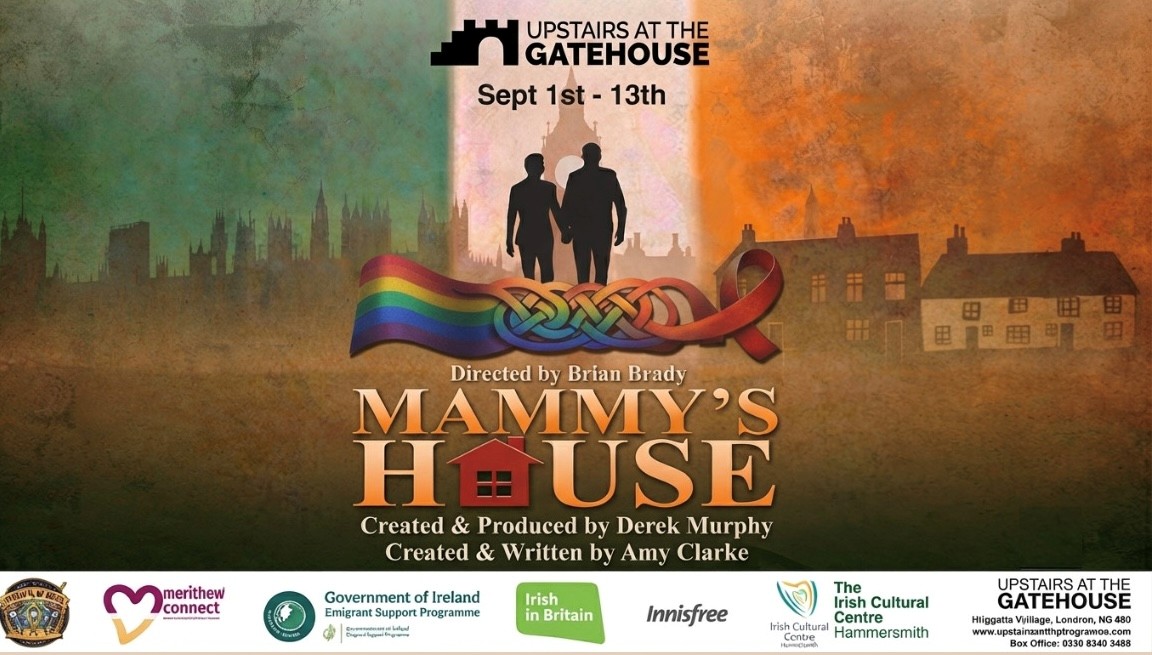
The production draws on first-hand testimony from London’s Irish LGBTQ+ community and will run at the theatre from the 1st to the 13th September.

It has been announced that the Amy Clarke (who also wrote) and Derek Murphy created show Mammy’s House will officially open at Upstairs at the Gatehouse on the 2nd September.
Camden, 1985. Behind the door of a London terrace, a queer Irish household is cobbling together a life filled with humour, drag, and a freedom they could never have imagined back home. But their community is on the edge of their greatest challenge yet. Being Irish in the UK is complicated. Being queer and Irish during the early years of the AIDS crisis is downright perilous.
Mammy’s house rises to meet the challenge; offering warmth, care, sarcasm, petty squabbling, and the fierce loyalty of chosen family. As the epidemic threatens to engulf them and the world turns away, this resilient group of gay and lesbian Irish people know they have survived shame before, and they intend to survive it again .
Directed by Brian Brady (Making History, Abbey Theatre; Dancing at Lughnasa, Olivier Theatre). Derek Murphy also stars as Barry, affectionately known as ‘Mammy’, alongside Stephen Cheriton (The Lehman Trilogy, Piccadilly Theatres; Yardbird, Hackney Empire), who plays Justin and Ginny Tonic. They are joined by Conor O’Dwyer (Homo(sapien), Theatre503; Dublin Murders, Euston Films), who plays both Niall and Nellie, Jemma Curran (Soulmate Wanted, Dún Laoghaire; Moone Boy, Baby Cow Productions), Justin Ensor (Girls & Boys, Gander Films; Flicker, Bold Puppy) and Ciara Pouncett (Draining the Swamp, UK Tour; Smothered, Sky Original), who play Mags, Shay and
Sally respectively.
Duncan Murphy and Amy Clarke spent two years developing the show, supported by the Emigrant Support Programme through the Embassy of Ireland in Great Britain, The Irish Cultural Centre and the Meitheal Muintire Irish End-of-Life Care Project, in association with Innisfree Housing. Working closely with members of London’s Irish LGBTQ+ community, they drew on lived experience to ensure the production authentically reflects the period. Amongst those contributing their experiences were activist and priest Bernárd Lynch, one of the first people to bring HIV/AIDS to national attention in Ireland, and historian Dr Joseph Healy, founder of the London Irish LGBT Network and a longstanding campaigner for LGBTQ+ rights within the Irish community.
Performer and producer Derek Murphy, commented: “We want to create a space where the Irish diaspora and the LGBTQ+ community can see their shared history reflected with dignity, humour, and truth. We wish to establish this story in the theatrical canon so that these vital voices are never deemed “disposable” ever again.”
Meanwhile, Amy Clarke said: “We saw a gap in our history, a ‘double exile’ of being queer and
Irish in a city that wasn’t always welcoming to its Irish residents. We aren’t just devising a play; we’re documenting a community that was almost lost to silence.”
To book tickets click here.